
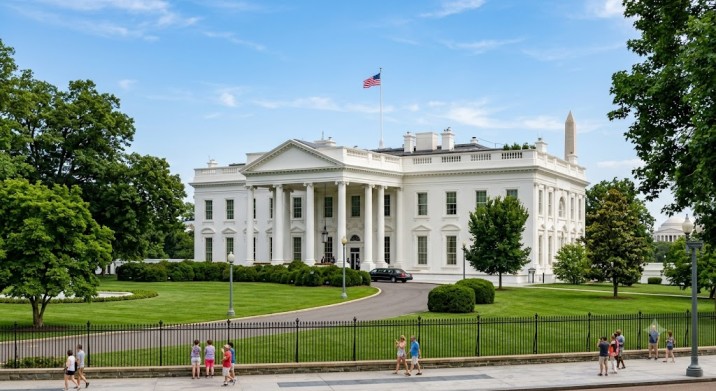
Following Argentina’s semi-final win over England in the World Cup, the White House has come to the defense of Argentina’s national football team after players displayed a banner asserting Argentina’s claim to the Falkland Islands. This act has sparked renewed tension over the long-standing sovereignty dispute concerning the islands. The U.S. stance, articulated by Andrew Giuliani, head of the White House FIFA taskforce, emphasizes support for freedom of expression, a principle he views as essential in this situation.
This development, however, has not been well-received in the United Kingdom. British officials have expressed disapproval of the banner, arguing that it breaches regulations prohibiting political statements in football. They have urged FIFA to conduct an investigation into whether the display violated these rules. In response, FIFA has acknowledged the need to review the incident as part of its disciplinary procedures, which are designed to maintain the apolitical nature of the sport.
The incident has once again brought the issue of the Falkland Islands, a subject of contention between Argentina and the United Kingdom for decades, to the forefront of international discussion. The Falkland Islands government has publicly criticized the display, labeling it as inappropriate. They have called upon FIFA to enforce its policy of keeping political matters separate from sporting events, underscoring the importance of this principle in maintaining the integrity of international competitions.
While the display by the Argentine team has reignited diplomatic tensions, the White House’s position reflects a broader commitment to freedom of speech, even within the context of international sports. This stance may complicate relations with the United Kingdom, but it remains consistent with U.S. values. As FIFA continues its review, the international community watches closely to see how this incident will be resolved and what implications it might have for future sporting events.