
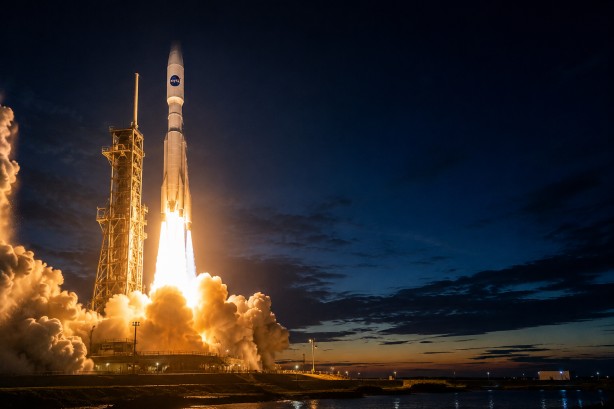
NASA’s latest endeavor, the Nancy Grace Roman Space Telescope, has successfully launched from the Kennedy Space Center in Florida, embarking on a mission to explore some of the universe’s most profound mysteries. This $4.3 billion telescope, carried by a SpaceX Falcon Heavy rocket, is set to travel nearly one million miles from Earth. Its mission is to delve into the realm of exoplanets, investigate the formation of planets and galaxies, and provide insights into dark matter and dark energy. This launch signifies the beginning of a new chapter in space exploration, following nearly a decade of development efforts.
Equipped with a 300-megapixel infrared camera, the Roman Space Telescope will complement the work of both the Hubble and James Webb Space Telescopes. It promises to deliver images with a resolution akin to Hubble’s but over a field of view at least 100 times larger, capturing areas of the sky approximately 1.5 times the apparent size of the full Moon. Furthermore, the telescope features a coronagraph, a pivotal instrument that can block the bright light of stars, enabling researchers to study planets in greater detail, including older and colder planets that orbit closely to their stars.
The Roman Telescope will be stationed at the Sun-Earth Lagrange Point 2, a stable area in space also utilized by the James Webb Space Telescope. From this vantage point, it will carry out a diverse array of observations over its primary five-year mission, which has the potential to be extended. The wide-field observations conducted by Roman are expected to aid in the identification of targets for more focused studies by both Hubble and Webb, potentially uncovering previously unseen worlds beyond our solar system.
Scientists anticipate the telescope’s first scientific images to be released in early 2027, following extensive testing and calibration phases. This mission is particularly noteworthy as it overcame proposed budget cuts to NASA’s science programs, with Congress ultimately securing its funding. By making Roman’s images publicly accessible, NASA aims to provide both researchers and amateur astronomers with a vast new repository of astronomical data, advancing our understanding of the universe’s expansion, planetary formation, and cosmic evolution over billions of years.