
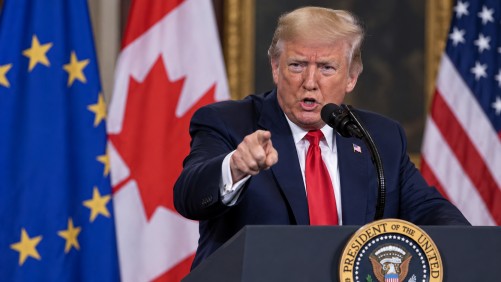
President Donald Trump has sharply criticized the European Union’s proposal to offer Canada associate membership, labeling the idea as “laughable” and threatening potential tariffs on European goods. This development comes as the EU seeks to forge stronger ties with Canada in several sectors, including technology, defense, and energy.
Trump described the EU’s invitation to Canada as a potential “hostile act,” suggesting that the United States might respond by imposing heavy tariffs on European products or by reducing trade with the bloc. The U.S. response, he noted, would depend on the perceived intent of the EU’s initiative.
The proposal for Canada to become the EU’s first associate member was extended by European Commission President Ursula von der Leyen. This move aims to strengthen collaboration between Ottawa and Brussels amid increasing challenges to the international rules-based system. While the EU and Canada already maintain a trade agreement, von der Leyen emphasized the need for a broader “alliance for the future,” covering areas like artificial intelligence, critical minerals, and cybersecurity.
The concept of associate membership in the EU is unprecedented, as there is currently no formal category for such an arrangement. Norway, Iceland, and Switzerland, while not EU members, maintain close economic ties with the bloc, serving as potential models for a similar relationship with Canada.
Canada, seeking to diversify its defense partnerships, has also applied to join the British-led Joint Expeditionary Force, a rapid-response military coalition involving several NATO member states. This initiative reflects a broader Canadian strategy to expand its alliances beyond the traditional reliance on the United States.
The EU’s proposal is still in the discussion phase, with details yet to be finalized. As Ottawa and Brussels explore this new avenue for cooperation, Trump’s threat of tariffs introduces a potential complication in the evolving geopolitical landscape.