
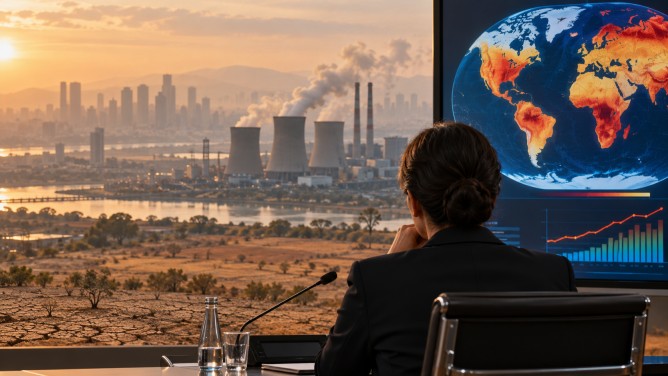
The United Nations Environment Programme (UNEP) has issued a stark warning that global greenhouse gas emissions must be curtailed significantly to mitigate the worst impacts of climate change. According to their report, emissions need to decrease by 18% by 2030 and 45% by 2045 to enhance the likelihood of keeping global temperature rise within 1.7°C above pre-industrial levels.
The UNEP report highlights that the world is currently off track to meet the 1.5°C warming limit established under the Paris Climate Agreement. Nonetheless, the possibility of limiting both the extent and duration of temperature overshoot exists if governments implement urgent and effective measures.
While global emissions in 2025 remained relatively stable compared to the previous year, experts caution against interpreting this as a sign of long-term decline. Despite the rapid expansion of renewable energy sources, reliance on fossil fuels and uncertainty in climate policies continue to pose significant challenges.
The report also criticizes the inadequacy of updated national climate commitments. Even if countries fulfill their current pledges, global temperatures could still rise by about 2.6°C above pre-industrial levels. Under existing policies, this warming might reach 2.8°C, thereby heightening the risks of extreme weather events, agricultural losses, and other climate-related disasters.
Climate experts are urging major fossil fuel-producing nations to expedite the transition to cleaner energy and to bolster their emissions-reduction strategies. Although renewable energy technologies like solar and wind are expanding, political action has not matched the pace of scientific recommendations.
Reducing methane emissions is also emphasized as a critical step to slowing global warming, given methane’s powerful short-term warming effect compared to carbon dioxide. Experts stress the need for governments to act swiftly to bridge the gap between their climate commitments and actual policies.
Upcoming global climate assessments by the UN are anticipated to play a crucial role in reviewing national progress and promoting stronger commitments. Scientists warn that any delay in action could increase the chance of irreversible changes in the climate system.